

Hybrid work isn’t a trend. It’s a permanent shift in how people relate to their workday, and more importantly, to one another. What’s changing isn’t whether people come into the office, but why they come in.
Today’s teams step into the workplace with a clear purpose: connection, clarity, creativity, and access to the people and tools that help them do their best work.
That means the physical workplace can’t stay frozen in pre-2020 habits. It has to evolve just as quickly as the teams inside it.
As 2026 begins, now is the perfect moment to step back, evaluate your space, and ask a simple but powerful question:
Does our environment support the way our people work today?
Here are the three areas every organization should be thinking about, and how space design can transform each one.
Connection: The Heartbeat of a High-Performing Team
In a hybrid world, connection has become the new gravity — it’s what pulls people into the office.
Employees want the in-person moments that can’t be replicated on a screen: spontaneous collaboration, deeper conversations, and the genuine feeling of being part of something bigger.
The challenge?
Many offices were built around rows of desks that don’t support how teams connect now.
Spaces that strengthen connection look different today.
They include:
- Welcoming social zones where teams can gather naturally
- Comfortable, hospitality-inspired areas that feel less corporate
- Touchdown spots for quick syncs
- Flexible commons that shift from team meeting to lunch to workshop
When the space invites connection, coming into the office stops feeling mandatory — and starts feeling meaningful.
Focus: Because Deep Work Still Matters
With more activity happening in open collaboration zones, employees need a different kind of balance:
places where they can think, concentrate, and stay grounded in their work.
The modern office must offer layers of focus, not a single solution.
That means:
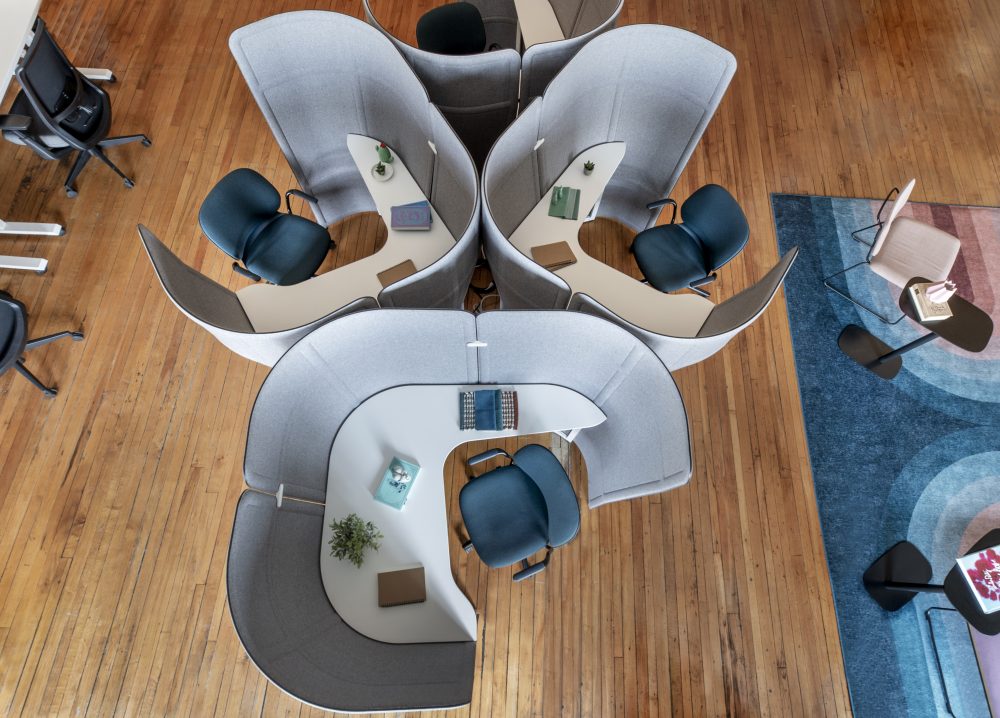
- Enclosed private spaces for heads-down work
- Quiet nooks that remove distractions
- Phone rooms for uninterrupted calls
- Acoustic elements that support both energy and concentration
- Workstations designed for ergonomics and flow
When people know they can come to the office and actually get work done, the space becomes a competitive advantage, not a frustration.
Flexibility: Because No One Can Predict What’s Next
Hybrid work is fluid by design.
Your space should be too.
The most effective workplaces in 2026 will be the ones that adapt, sometimes daily, based on team needs, meeting formats, and the natural rhythm of work.
That’s where flexibility comes in.
Consider adding:
- Mobile tables and seating that can be rearranged in minutes
- Multi-use rooms that shift between workshop, huddle, and lounge
- Storage solutions that keep clutter out of sight
- Modular furniture that evolves as you do
- Tech-enabled spaces that support in-person and virtual collaboration
A flexible environment gives your team permission to work the way they work best, without being boxed in by outdated layouts.
The Bottom Line: Your Space Should Strengthen Your Culture
Hybrid isn’t going away.
But the workplace is no longer just a place to “go to work.”
It’s a tool, one of the most powerful tools you have, to strengthen your culture, support your people, and inspire performance.
If your environment feels out of sync with the way your team works today, you’re not alone. Many organizations are reimagining their spaces to create more connection, more clarity, and more energy.
And you don’t have to go through that exploration alone.
Connect with our team to see how we can help.